Composable Frontend Architecture
Building Adaptive, Scalable, and Intelligent Interfaces
By Everett Quebral
Introduction
Why Composable Frontend Architecture?
The modern web is overwhelmed by complexity. Monolithic frontends are becoming brittle, and micro frontends often introduce more chaos than clarity. We need a new paradigm—one that embraces modularity, reusability, intelligence, and adaptability at scale. That’s where Composable Frontend Architecture enters the scene.
This book is a deep dive into a new architectural foundation designed to move beyond the limitations of traditional frontend patterns. Grounded in principles like composability, hexagonal and reactive design, and modular governance, this book introduces a framework for building modern frontends that scale with both business and technical complexity.
Whether you're an architect rethinking a legacy system, a senior developer building for scale, or a CTO leading digital transformation, this book equips you with the concepts, workflows, and case studies to modernize with confidence.
Together, we’ll explore:
Composability beyond components Execution layers that adapt intelligently Reactive interfaces driven by data flow Real-world strategies from companies transforming their stack Let’s build frontends like we build platforms: intentionally, intelligently, and composably.
Table of Contents
📘 Introduction
Why Composable Frontend Architecture?
Explore the need for a new paradigm in frontend development that embraces modularity, reusability, and adaptability.
📘 Introduction
- Why Composable Frontend Architecture?
🧱 Part I: Foundations of Composability
The Composable Mindset
Rethinking scale, adaptability, and platform thinking.Architectural Roots
From hexagonal and reactive foundations to composable systems.Evolution of the Frontend
Monoliths, micro frontends, and the rise of composable architecture.
🧩 Part II: Pillars of Composable Frontend Architecture
Composable Execution Layer (CEL)
Composable Execution LayerModular Interaction Layer (MIL)
Modular Interaction Layer (MIL)Data-Driven Presentation Layer (DPL)
Data-Driven Presentation LayerCross-Surface Execution Engine (CSEE)
Cross-Surface Execution Engine (CSEE)Composable Runtime Shell (CRS)
Composable Runtime Shell (CRS)Universal Interaction Framework (UIF)
Universal Interaction Framework (UIF)Governance and Lifecycle Management
Governance in Composable Architecture
🚀 Part III: Strategies and Case Studies
- Breaking the Monolith
- Governance in Practice
- Composable Frontends in the Wild
- Designing Your Own Composable System
📎 Appendices
- A. Reference Implementation in React and Web Components
- B. Tooling and DevOps for Composable Teams
- C. Glossary of Terms and Principles
Page 1/3

AI Observability Is Decision Reconstruction
How to trace context, model decisions, tool effects, policy, and evidence so agent behavior can be understood and improved after the run.- Published on

Prompt Injection Is a Trust Boundary Problem
Why agent security depends on separating instructions from untrusted content, constraining authority, tracking provenance, and verifying effects outside the model.- Published on

Idempotency for AI Agents
Why retries, partial failures, and long-running agent loops make idempotent actions, reconciliation, and explicit operation identity essential.- Published on

Human Approval Is an Architectural Boundary
How to place human judgment at consequential transitions without turning AI workflows into notification queues or rubber-stamp theater.- Published on

Agent Memory Without the Mythology
A practical architecture for AI memory built from working state, durable facts, episodic records, retrieval policy, and deliberate forgetting.- Published on

Context Engineering Is Interface Design
How to design the information boundary around an AI agent so instructions, evidence, tools, and working state remain legible under pressure.- Published on

Composable AI Systems: Architecture That Can Change Without Losing Control
A practical architecture for building AI systems from bounded capabilities, explicit contracts, least-privilege tools, durable state, and verification gates.- Published on

The Agent Harness Is the Real Product
Why model capability only becomes dependable work through a harness that manages context, tools, state, permissions, recovery, and verification.- Published on
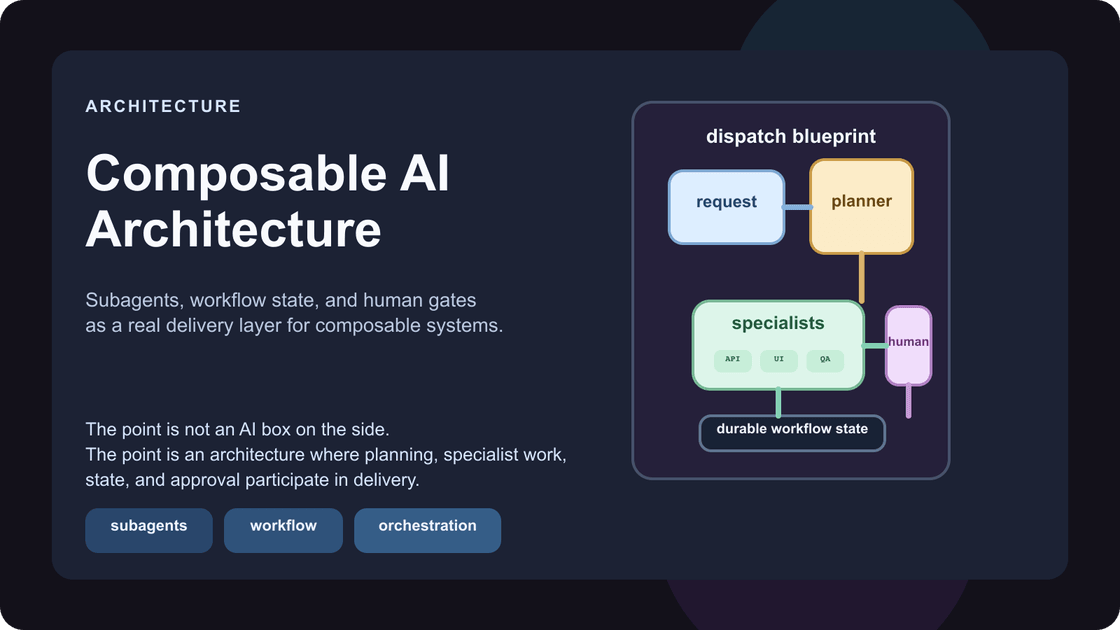
Composable AI Architecture
How subagents, workflow orchestration, and durable state turn AI from a bolt-on assistant into a composable delivery capability.- Published on